
|
Getting your Trinity Audio player ready...
|
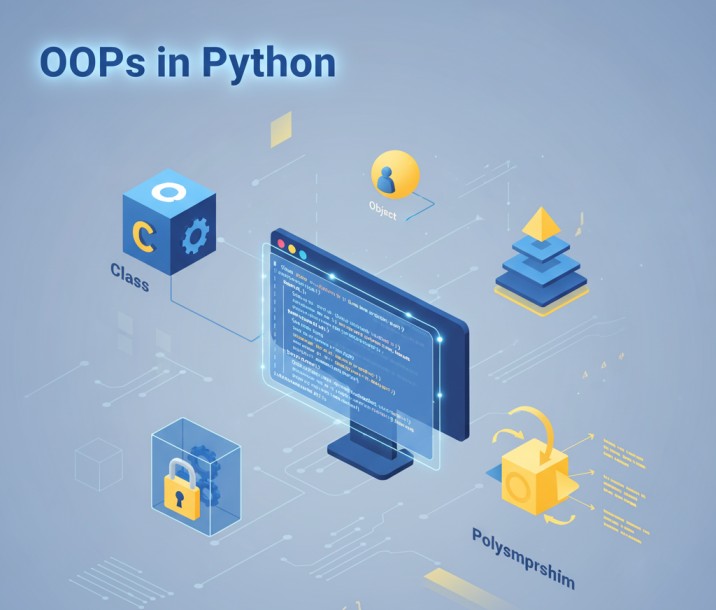
Python is an object-oriented language, which means it supports the principles of Object-Oriented Programming (OOP) such as classes, objects, inheritance, encapsulation, and polymorphism.
OOPs in Python helps make code modular, reusable, and organized — ideal for large and complex projects.
What is OOP?
Object-Oriented Programming (OOP) is a programming paradigm where everything is represented as an object that contains data and methods to operate on that data.
Example:
car = {
    "brand": "Toyota",
    "model": "Corolla",
    "year": 2022
}
Here, car has properties — but in OOP, we would create a Car class and then make multiple car objects from it.
Why OOP?
| Problem (in Procedural Code) | Solution (with OOP) |
|---|---|
| Hard to manage large code | Organize into classes |
| Repeated code | Use inheritance |
| No data security | Encapsulation |
| Limited flexibility | Polymorphism |
1. Classes and Objects
A Class is a blueprint for creating objects.
An Object is an instance of a class — a real-world entity.
Example:
class Car:
    def __init__(self, brand, model):
        self.brand = brand
        self.model = model

    def display_info(self):
        print(f"Car: {self.brand} {self.model}")

# Creating objects
car1 = Car("Toyota", "Corolla")
car2 = Car("Tesla", "Model 3")

car1.display_info()
car2.display_info()
✅ Output:
Car: Toyota Corolla
Car: Tesla Model 3
Explanation:
__init__()→ constructor method (runs automatically when object is created)self→ refers to the current instance of the class
2. Class and Instance Variables
- Class Variables → shared across all objects
- Instance Variables → unique for each object
Example:
class Student:
    school = "SmartTejas Academy"   # class variable

    def __init__(self, name, grade):
        self.name = name            # instance variable
        self.grade = grade

s1 = Student("Amit", "A")
s2 = Student("Priya", "B")

print(s1.school)  # SmartTejas Academy
print(s2.name)    # Priya
3. Types of Methods in Python
| Type | Description | Example |
|---|---|---|
| Instance Method | Operates on instance data | def display(self): |
| Class Method | Works on class-level data | @classmethod |
| Static Method | Independent utility method | @staticmethod |
Example:
class MathUtils:
    count = 0

    def __init__(self):
        MathUtils.count += 1

    @classmethod
    def total_objects(cls):
        print(f"Total objects created: {cls.count}")

    @staticmethod
    def add(a, b):
        return a + b

MathUtils.add(5, 7)
obj1 = MathUtils()
obj2 = MathUtils()
MathUtils.total_objects()
✅ Output:
Total objects created: 2
Read More: Date and Time in Python
4. Encapsulation
Encapsulation means protecting data (variables) from direct access and modification.
Example:
class BankAccount:
    def __init__(self, balance):
        self.__balance = balance   # private variable

    def deposit(self, amount):
        self.__balance += amount

    def get_balance(self):
        return self.__balance

acc = BankAccount(1000)
acc.deposit(500)
print(acc.get_balance())  # ✅ 1500
print(acc.__balance)      # ❌ AttributeError
✅ Use __ (double underscore) to make a variable private.
5. Inheritance
Inheritance allows a new class (child) to reuse and extend functionality from an existing class (parent).
Types of Inheritance:
- Single
- Multiple
- Multilevel
- Hierarchical
- Hybrid
Example (Single Inheritance):
class Vehicle:
    def start(self):
        print("Vehicle started")

class Car(Vehicle):
    def drive(self):
        print("Car is driving")

c = Car()
c.start()
c.drive()
✅ Output:
Vehicle started
Car is driving
Read More: Inheritance in Python
6. Method Overriding
If a child class defines a method with the same name as the parent, the child’s method overrides the parent’s version.
Example:
class Animal:
    def sound(self):
        print("Some sound")

class Dog(Animal):
    def sound(self):
        print("Bark Bark!")

d = Dog()
d.sound()
✅ Output:
Bark Bark!
7. Polymorphism
Polymorphism allows methods with the same name to behave differently for different objects.
Example:
class Cat:
    def speak(self):
        return "Meow"

class Dog:
    def speak(self):
        return "Woof"

for animal in [Cat(), Dog()]:
    print(animal.speak())
✅ Output:
Meow
Woof
8. Operator Overloading (Polymorphism in Action)
Python allows you to customize operators (like +, -, <, etc.) for your own classes.
Example:
class Point:
    def __init__(self, x, y):
        self.x = x
        self.y = y

    def __add__(self, other):
        return Point(self.x + other.x, self.y + other.y)

p1 = Point(2, 3)
p2 = Point(4, 5)
p3 = p1 + p2

print(p3.x, p3.y)
✅ Output:
6 8
9. Abstraction
Abstraction means hiding implementation details and showing only necessary features.
Example:
from abc import ABC, abstractmethod

class Shape(ABC):
    @abstractmethod
    def area(self):
        pass

class Circle(Shape):
    def __init__(self, r):
        self.r = r
    def area(self):
        return 3.14 * self.r * self.r

c = Circle(5)
print(c.area())
✅ Output:
78.5
You can’t instantiate abstract classes directly.
10. Example: Employee Management System
class Employee:
    company = "TechCorp"

    def __init__(self, name, salary):
        self.name = name
        self.salary = salary

    def display(self):
        print(f"{self.name} earns {self.salary}")

class Manager(Employee):
    def __init__(self, name, salary, department):
        super().__init__(name, salary)
        self.department = department

    def display(self):
        print(f"{self.name} manages {self.department} department and earns {self.salary}")

# Create objects
e1 = Employee("Amit", 50000)
m1 = Manager("Priya", 80000, "IT")

e1.display()
m1.display()
✅ Output:
Amit earns 50000
Priya manages IT department and earns 80000
11. Benefits of OOPs in Python
| Benefit | Description |
|---|---|
| Modularity | Code organized into reusable classes |
| Reusability | Use existing classes in new projects |
| Extensibility | Add new features without breaking existing code |
| Maintainability | Easier to debug and update |
| Security | Encapsulation protects data |
12. Summary Table of Key OOP Concepts
| Concept | Meaning | Keyword / Example |
|---|---|---|
| Class | Blueprint | class Car: |
| Object | Instance | car1 = Car() |
| Constructor | Initialize object | def __init__() |
| Inheritance | Reuse parent class | class Child(Parent) |
| Polymorphism | Same method, different behavior | def sound() |
| Encapsulation | Data hiding | __private_var |
| Abstraction | Hiding details | @abstractmethod |
Real-World Use Cases of OOPs in Python
| Industry | Example |
|---|---|
| Data Science | Model wrappers, pipeline classes |
| Web Development | Django Models, Flask Views |
| Automation | Class-based task managers |
| Game Development | Characters, weapons, enemies as objects |
| AI Assistants | Class-based command, intent, and speech modules |
Conclusion
Object-Oriented Programming (OOP) in Python gives structure and flexibility to your code.
Once you master classes, inheritance, and polymorphism — you can easily build large systems like AI assistants, dashboards, and ML frameworks efficiently.
What’s Next?
In the next post, we’ll learn about the Inheritance in Python