
|
Getting your Trinity Audio player ready...
|
Management Information Systems (MIS) is where business thinking meets the power of data and technology. MIS professionals turn everyday business questions into clear, data-driven insights, build smart reports and dashboards, automate repetitive work, and enable managers to make faster, better decisions. As organisations move deeper into digital transformation in 2026, MIS is no longer just a support role—it’s a strategic, high-impact, and highly rewarding career path.
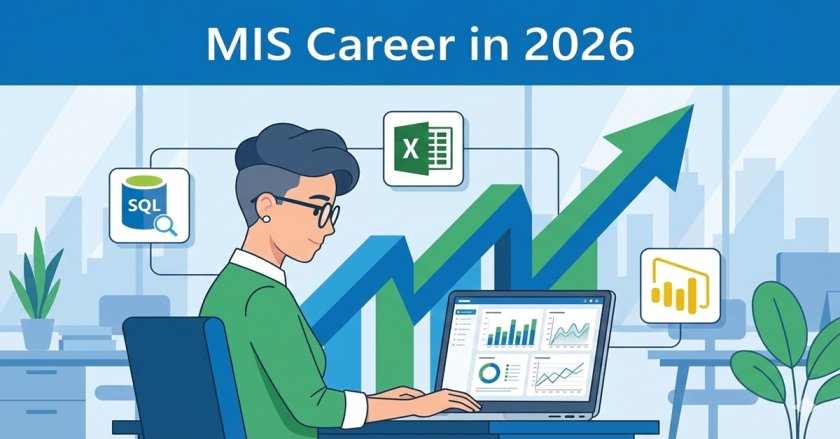
This article explains the scope of MIS, what employers expect in 2026, the technical and soft skills you need, realistic salary ranges, career progression, and practical steps to launch or advance your MIS career. It’s written in simple, easy-to-follow language and packed with real-world advice for students, early-career professionals, and career-switchers.
1. What is MIS — a clear definition
Management Information Systems (MIS) is the practice of using people, processes, and technology to collect, process, and present information that supports managerial decision-making. An MIS professional typically:
- Gathers business requirements from stakeholders
- Designs reports and dashboards (MIS reports)
- Builds workflows and automations to streamline operations
- Ensures data quality and governance
- Works closely with IT, business users, and sometimes data science teams
Think of MIS as the bridge between “what the business needs” and “what technology can deliver”.
Read More: Excel Tutorials
2. Why MIS is relevant in 2026 (scope & demand)
Several forces keep MIS in demand:
- Digital transformation: Companies across industries (government, manufacturing, healthcare, retail, finance) automate processes and need people who can convert business needs into reports, KPIs and processes.
- Data-driven decision making: Managers continue to rely on dashboards and regular reports to run operations; MIS professionals build and maintain these artefacts.
- Platform proliferation: Cloud ERPs, CRM systems, business intelligence tools, and low-code automation platforms create demand for professionals who can integrate and operate them.
- SME adoption: Small and mid-sized enterprises increasingly adopt MIS practices (not just big companies), widening job opportunities.
- Remote & hybrid work: Decentralised teams need standardised dashboards, reporting SLAs and automated alerts — core MIS deliverables.
In short, MIS is practical and business-critical — and it stays relevant because businesses always need reliable operational information.
3. Common MIS job roles & responsibilities
Here are typical roles you’ll find:
- MIS Executive / MIS Analyst (Entry-level)
- Prepare daily/weekly/monthly reports
- Maintain spreadsheets and data sources
- Support users with ad-hoc queries
- MIS Officer / Senior MIS Analyst
- Build dashboards (Power BI / Tableau / Zoho Analytics)
- Automate data pipelines (ETL scripts, connectors)
- Ensure data quality and document requirements
- MIS Manager / Reporting Manager
- Lead MIS team, define reporting standards and SLAs
- Liaise with stakeholders, own KPIs and dashboards
- Drive automation & process improvements
- Business Intelligence (BI) Developer / Data Analyst
- Develop complex ETL, SQL models, analytical dashboards
- Conduct deeper analysis supporting strategy
- MIS Architect / Data Ops Lead
- Design reporting architecture and governance
- Integrate multiple systems, set standards for data lineage
4. Must-have technical skills (2026 edition)
Employers want people who can deliver quickly and reliably. Key skills:
Core technical skills
- SQL: Essential. Ability to write efficient SELECT queries, joins, aggregates, window functions.
- Excel / Google Sheets: Strong proficiency (pivot tables, advanced formulas, QUERY, dynamic arrays).
- BI tools: Power BI, Tableau, Looker, Zoho Analytics — know one or two well.
- ETL / Data pipelining: Basic scripting (Python or R) and familiarity with tools (Airflow, Talend, Azure Data Factory) for automation. For many MIS roles, simple scripts or Google Apps Script / VBA / Power Automate are enough.
- Databases: Understand relational databases (MySQL, PostgreSQL, SQL Server) and cloud data storage (BigQuery, Redshift).
- Reporting automation: Ability to schedule & distribute reports, build refreshable dashboards.
- APIs & integration: Basic understanding to pull/push data via REST APIs (Requests in Python, Postman).
- Data cleaning & validation: Use of Pandas or built-in BI data prep features.
Desirable/advanced skills
- Basic analytics & statistics: Mean, median, trend analysis, moving averages, seasonal adjustments.
- Scripting for automation: Python knowledge to automate repetitive tasks.
- Version control: Git basics for collaborative code/report development.
- Cloud familiarity: Basic exposure to cloud platforms (AWS/Azure/GCP) is a plus.
5. Essential soft skills & domain understanding
Technical skills are necessary but not sufficient. Soft skills that make you effective:
- Business communication: Translate stakeholder needs into clear reporting requirements.
- Problem solving: Break complex requests into simple, repeatable solutions.
- Attention to detail: Small data issues can cause big reporting errors.
- Stakeholder management: Prioritise requests and set realistic timelines.
- Documentation: Maintain change logs, data dictionaries, and report specifications.
- Domain knowledge: Finance, supply chain, HR, or sales domain knowledge helps — you don’t need to be an expert, but understanding key metrics (e.g., gross margin, churn, lead conversion) is very useful.
6. Tools, platforms & certifications employers value
Popular tools (learn at least 2–3)
- Excel (advanced) — still indispensable
- Power BI — widely used for enterprise reporting
- Tableau — popular for visual analytics
- SQL Engines — MySQL, PostgreSQL, SQL Server
- Python + Pandas — for automation and data prep
- Google Sheets + Apps Script — great for light-weight automation
- Automation platforms — Power Automate, Zapier, Make (for workflow automation)
Read More: Python Tutorials
Useful certifications (helpful but optional)
- Microsoft Certified: Power BI Data Analyst Associate
- Google Data Analytics Certificate
- Tableau Desktop Specialist
- Certified Business Analysis Professional (CBAP) — for senior roles
- Domain-specific certificates (finance, supply chain) can add value
Certifications demonstrate focused learning but practical portfolio projects often matter more.
7. Salary expectations — realistic ranges and factors that affect pay
Salaries vary by geography, industry, company size, and experience. Instead of giving exact figures that can quickly become outdated, consider these realistic ranges and factors:
Factors that determine salary
- Experience: Entry-level vs 3–5 years vs Manager.
- Skill set: Strong SQL + BI + automation commands higher pay.
- Location: Large metro cities and global markets pay more than smaller towns.
- Industry: Finance, consulting, and tech firms generally pay better.
- Company size and budget: Startups vs enterprises.
Indicative picture (for context only)
- Entry-level MIS Analyst: Starting positions, learn-on-job — generally entry band.
- MIS Officer / Analyst (2–5 years): Mid band — better pay if proficient in SQL + BI tools.
- Senior MIS / BI Developer (5+ years): Higher band — for architects or BI leads.
- MIS Manager / Head of Reporting: Leadership pay with strategic responsibilities.
Tip: Use local job portals and salary aggregators to check up-to-date ranges in your city and industry. Companies often publish job bands which are the best single source for current pay levels.
8. Career growth path & transition opportunities
MIS offers a variety of growth routes:
Vertical growth
- MIS Analyst → Senior MIS Analyst → MIS Manager → Head of Reporting → Director (Analytics/BI)
Horizontal growth / transitions
- Move into Data Analyst or BI Developer roles (more analytics & modelling)
- Transition to Data Engineer (if you enjoy ETL, data pipelines)
- Move into Product / Operations / Consulting leveraging domain knowledge
- Build niche: Sales Operations / Supply Chain MIS / Financial MIS
Entrepreneurship
Experienced MIS professionals can freelance, consult, or start analytics services for SMBs.
9. How to enter MIS: step-by-step roadmap (for beginners)
- Learn Excel thoroughly — pivot tables, lookups, dynamic arrays.
- Master SQL basics — SELECT, JOIN, GROUP BY, window functions.
- Pick a BI tool — Power BI or Tableau; build 3–4 dashboards.
- Automate — learn Python basics or Google Apps Script for small automations.
- Build a portfolio — host sample dashboards, GitHub notebooks, or a public Google Sheets demo.
- Apply for internships / junior roles — target MIS analyst, operations analyst, reporting analyst.
- Keep learning & collect certificates — practical projects beat certificates alone.
10. How to upskill fast (resources & learning plan)
90-day focused plan
- Week 1-4: Excel + SQL basics (daily practice)
- Week 5-8: Power BI / Tableau (build 2 dashboards)
- Week 9-12: Python basics (Pandas) + small automation projects
- Build one capstone project: end-to-end reporting pipeline (CSV→ETL→BI dashboard)
Learning resources
- Official docs and guided labs (Power BI, Tableau)
- SQL practice sites (Mode SQL, LeetCode databases)
- Free courses on Coursera / edX / YouTube (practical-focused)
- Blogs, GitHub repos, and Smart Tutorials-style posts for applied examples
11. Challenges MIS professionals face and how to handle them
- Ambiguous requirements: Ask clarifying questions and create simple mockups.
- Data quality problems: Document issues, automate validations, set ownership.
- Stakeholder pressure: Use prioritisation and SLAs — show impact.
- Too many ad-hoc requests: Create a ticketing / prioritisation system — automate common ones.
- Keeping skills current: Dedicate weekly learning time, build side projects.
12. Tips to stand out in hiring and promotions
- Build a visible portfolio (dashboards + notebooks) — link in resume/LinkedIn.
- Show measurable impact: “Reduced manual report delivery time from 3 days to 2 hours.”
- Learn to tell stories with data — present insights, not only numbers.
- Automate repetitive tasks and document the savings.
- Network with domain teams — understand what they measure and why.
- Be proactive: propose small high-impact projects (alerts, automated KPIs).
Conclusion
MIS in 2026 remains a practical, future-ready career that rewards a blend of technical ability and business understanding. If you enjoy solving operational problems with data, automating repetitive work, and delivering clear reports that help managers make decisions, MIS is a great path.
Focus on SQL, Excel, one BI tool, basic automation skills, and clear communication. Build a portfolio of real projects, keep learning, and you’ll find steady demand, good career progression, and opportunities for specialization.