
|
Getting your Trinity Audio player ready...
|
Object-Oriented Programming (OOP) in Python allows developers to write clean, reusable, and maintainable code. One of its most powerful features is Inheritance — a mechanism that lets one class acquire properties and behaviors (methods and attributes) from another class.
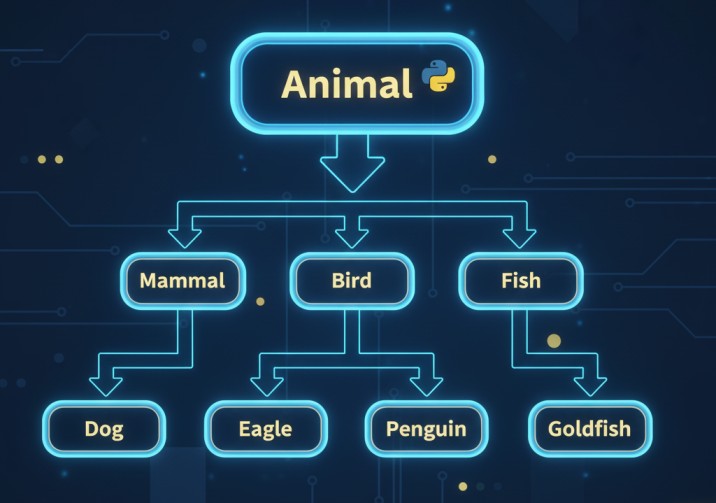
In this guide, you’ll learn what inheritance is, how it works, its types, and how to implement Inheritance in Python with clear examples.
What is Inheritance in Python?
Inheritance means creating a new class (child/subclass) from an existing class (parent/superclass).
The child class inherits the attributes and methods of the parent class, allowing you to reuse code without rewriting it.
Syntax:
class ParentClass:
    # parent class code

class ChildClass(ParentClass):
    # child class code
Example 1: Basic Inheritance
class Animal:
    def speak(self):
        print("Animal makes a sound")

# Dog class inherits from Animal
class Dog(Animal):
    def bark(self):
        print("Dog barks")

# Object of Dog
d = Dog()
d.speak()  # Inherited method
d.bark()   # Child class method
✅ Output:
Animal makes a sound
Dog barks
Here, the Dog class inherits the speak() method from the Animal class.
Why Use Inheritance?
- Code Reusability: Avoid rewriting the same code.
- Extensibility: Easily extend existing functionality.
- Maintainability: Makes code cleaner and easier to update.
- Organization: Keeps your code structured and logical.
Example 2: Using __init__() in Inheritance
class Person:
    def __init__(self, name, age):
        self.name = name
        self.age = age

class Student(Person):
    def __init__(self, name, age, student_id):
        super().__init__(name, age)  # Call parent constructor
        self.student_id = student_id

    def show(self):
        print(f"Name: {self.name}, Age: {self.age}, ID: {self.student_id}")

s = Student("Riya", 21, "ST123")
s.show()
✅ Output:
Name: Riya, Age: 21, ID: ST123
Here, super().__init__() helps call the parent class constructor.
The super() Function
super() is used to call a method of the parent class without explicitly naming it.
It’s most commonly used inside the __init__() method.
Example:
super().method_name()
This is useful for maintaining cleaner, modular code and especially when using multiple inheritance.
Types of Inheritance in Python
Python supports five types of inheritance:
| Type | Description | Example |
|---|---|---|
| Single Inheritance | Child inherits from one parent class | class B(A) |
| Multiple Inheritance | Child inherits from more than one parent | class C(A, B) |
| Multilevel Inheritance | Chain of inheritance | class C(B) where B(A) |
| Hierarchical Inheritance | Multiple child classes inherit from one parent | class B(A), class C(A) |
| Hybrid Inheritance | Combination of two or more inheritance types | Mix of above types |
Example 3: Single Inheritance
class Vehicle:
    def info(self):
        print("This is a vehicle")

class Car(Vehicle):
    def start(self):
        print("Car started")

obj = Car()
obj.info()
obj.start()
✅ Output:
This is a vehicle
Car started
Example 4: Multiple Inheritance
class Engine:
    def engine_info(self):
        print("Engine: V8")

class Body:
    def body_info(self):
        print("Body: Sedan")

class Car(Engine, Body):
    def car_info(self):
        print("Car: Mustang")

c = Car()
c.engine_info()
c.body_info()
c.car_info()
✅ Output:
Engine: V8
Body: Sedan
Car: Mustang
Python uses Method Resolution Order (MRO) to decide which parent’s method runs first in multiple inheritance.
Example 5: Multilevel Inheritance
class GrandParent:
    def feature1(self):
        print("Feature 1 from GrandParent")

class Parent(GrandParent):
    def feature2(self):
        print("Feature 2 from Parent")

class Child(Parent):
    def feature3(self):
        print("Feature 3 from Child")

c = Child()
c.feature1()
c.feature2()
c.feature3()
✅ Output:
Feature 1 from GrandParent
Feature 2 from Parent
Feature 3 from Child
Example 6: Hierarchical Inheritance
class Animal:
    def speak(self):
        print("Animal speaks")

class Dog(Animal):
    def bark(self):
        print("Dog barks")

class Cat(Animal):
    def meow(self):
        print("Cat meows")

d = Dog()
c = Cat()

d.speak()
c.speak()
✅ Output:
Animal speaks
Animal speaks
Example 7: Hybrid Inheritance
class A:
    def methodA(self):
        print("Method A")

class B(A):
    def methodB(self):
        print("Method B")

class C(A):
    def methodC(self):
        print("Method C")

class D(B, C):
    def methodD(self):
        print("Method D")

d = D()
d.methodA()
✅ Output:
Method A
Method Resolution Order (MRO)
When multiple inheritance is used, Python determines which method to call first using MRO.
You can check it using:
print(D.mro())
✅ Example output:
[<class '__main__.D'>, <class '__main__.B'>, <class '__main__.C'>, <class '__main__.A'>, <class 'object'>]
Key Takeaways
- Inheritance allows code reuse and logical hierarchy.
- Use super() to call parent class methods.
- Python supports single, multiple, multilevel, hierarchical, and hybrid inheritance.
- MRO decides the method call order in multiple inheritance.
- Inheritance makes your code cleaner, modular, and extensible.
Real-Life Analogy
Think of inheritance like a family tree:
- A Parent class defines general traits (like
name,age). - A Child class inherits them and adds its own traits (like
student_id,marks).
This makes code more organized and realistic — just like real-world relationships.
Practice Challenge
Try creating a simple class structure:
Employee(base class)ManagerandDeveloper(derived classes)- Add common methods like show_details() and specific ones like assign_task() or write_code().
Conclusion
Inheritance is the foundation of Object-Oriented Programming in Python.
It simplifies complex systems by allowing you to build on top of existing code rather than starting from scratch.